

Creating the conditions to enable and empower individuals, teams and organisations to thrive.
Workplaces are complex because humans are complex.
People do not experience leadership, culture, safety, wellbeing, work design, systems, change and performance as separate functions. They experience the workplace as a whole.
That is why psychosocial risk cannot be effectively understood or addressed in isolation.
Psychosocial hazards are often symptoms of broader organisational conditions:
-
how work is designed,
-
how leaders lead,
-
how decisions are made,
-
how change is managed,
-
how people are treated, and
-
whether systems enable people to do good work or constantly get in their way.
At We Are Human Co, we take a broader, holistic view and help organisations design workplaces that work for humans and enable sustainable organisational performance.
Our Human-Centred Workplace Design approach brings together people, leadership, culture, safety, wellbeing, systems, work design and employee experience to create the conditions in which individuals, teams and organisations can thrive.
Beyond Psychosocial Safety
Many organisations are being encouraged to “solve” psychosocial risk through surveys, risk registers, policies, training programs and wellbeing initiatives.
These may all play a role. But none of them, on their own, create a healthy, safe or high-performing workplace.
A psychosocial risk assessment may identify excessive workloads, poor role clarity, low support, organisational injustice or inadequate change management.
But identifying a hazard does not automatically change the conditions creating it.
A leadership workshop may increase awareness. But awareness alone does not redesign work, remove unnecessary barriers or change organisational systems.
A wellbeing program may provide support. But it cannot compensate for unclear expectations, unsustainable workloads, poor leadership, low trust or constant organisational friction.
That is why we do not approach psychosocial safety as a standalone initiative, compliance exercise or isolated area of risk.
We look at the whole workplace.
Because psychosocial safety is not simply something an organisation implements. It is an outcome of how work is designed, led and experienced.


What is Human-Centred Workplace Design?
Human-Centred Workplace Design is a holistic approach to shaping the conditions in which people work.
It examines the full employee experience and the interconnected factors that influence safety, wellbeing, culture, performance and organisational effectiveness.
It asks questions such as:
-
Is work clear, meaningful, manageable and sustainable?
-
Do people have the resources, information and authority they need to do their jobs?
-
Do leaders understand how their behaviour shapes the employee experience?
-
Are people involved in decisions that affect their work?
-
Do systems and processes support people or create unnecessary friction?
-
Is change managed transparently, fairly and humanely?
-
Can people raise concerns, ask questions, admit mistakes and contribute ideas?
-
Do teams have the trust, clarity and capability needed to perform?
-
Are safety, wellbeing and performance designed into work rather than added around its edges?
The aim is not simply to reduce harm. It is to intentionally create the conditions that enable people to do good work, safely and sustainably.
Our approach
We do not arrive with a generic psychosocial safety program and attempt to fit your organisation into it.
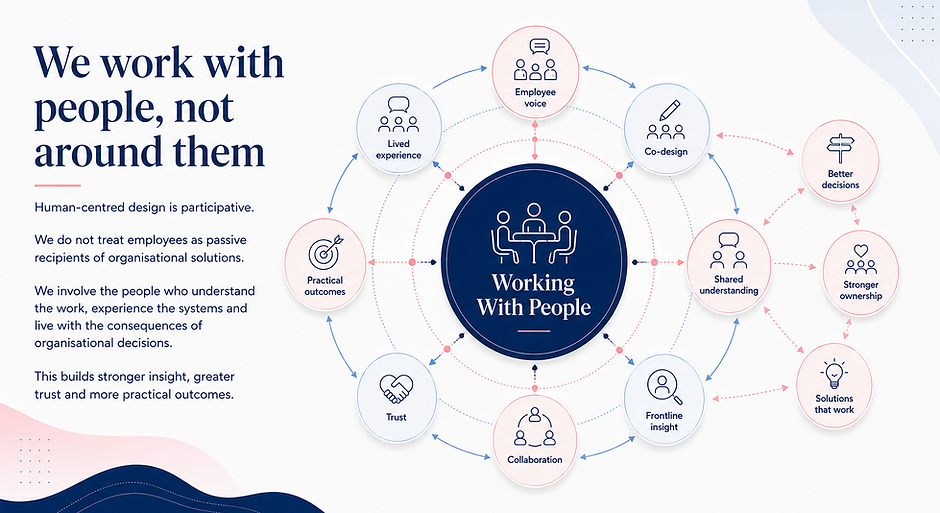
We work with you to understand how your workplace actually operates and how people genuinely experience it.
Our approach is practical, evidence-informed and tailored to the organisation, its people, its work and its operating environment.

Workplaces are interconnected human ecosystems.
-
A workload issue may be linked to role design, resourcing, capability, decision-making, technology, customer expectations or leadership behaviour.
-
A culture issue may be shaped by performance measures, competing priorities, unclear accountability or organisational history.
-
A wellbeing concern may not be a wellbeing issue at all. It may be the predictable result of poorly designed work.
We look beyond the presenting issue to understand the people, relationships, structures, systems and conditions contributing to it.



The conditions that help people and organisations thrive
Our Human-Centred Workplace Design framework considers the interconnected conditions that shape both human and organisational performance.
Work design
We examine whether work is structured in a way that is clear, achievable, meaningful and sustainable.
This can include:
-
workload and work pace;
-
role clarity and competing demands;
-
decision-making authority;
-
resources and staffing;
-
job control and autonomy;
-
task design;
-
workflow and work allocation;
-
recovery and fatigue;
-
physical and digital work environments.
Good work design does not remove every challenge.
It ensures that the demands placed on people are supported by appropriate resources, capability, clarity and control.
Leadership experience
Leadership is one of the strongest influences on how people experience work.
We help leaders understand the impact of their behaviour, communication, decisions and responses under pressure.
This includes:
-
leadership capability;
-
trust and psychological safety;
-
communication and consultation;
-
fairness and consistency;
-
empathy and accountability;
-
decision-making;
-
conflict and difficult conversations;
-
leading through uncertainty;
-
recognising and responding to signs of pressure or distress.
Human-centred leadership is not about avoiding accountability or lowering expectations.
It is about creating the conditions in which people can meet expectations, contribute meaningfully and perform at their best.
Employee experience
Employee experience is created through thousands of everyday interactions.
It is shaped by what people see, hear, feel and encounter from the moment they join an organisation to the moment they leave.
We examine:
-
recruitment and onboarding;
-
communication;
-
access to information;
-
systems and processes;
-
recognition;
-
development;
-
performance management;
-
inclusion and belonging;
-
support during difficult moments;
-
exit and transition experiences.
The employee experience is not separate from safety, culture or performance.
It is where all of these are felt.
Culture and relationships
Culture is not what is written on the wall.
It is what is encouraged, accepted, rewarded, challenged and repeated.
We explore the conditions that influence:
-
trust;
-
respect;
-
inclusion;
-
belonging;
-
collaboration;
-
psychological safety;
-
voice and participation;
-
conduct and behavioural standards;
-
conflict;
-
team dynamics;
-
organisational justice.
Healthy cultures are not conflict-free.
They are environments where people can raise concerns, disagree constructively, repair relationships and learn.
Organisational systems
Sometimes people are blamed for outcomes created by the systems around them.
We examine whether organisational structures, processes and technologies enable people to do good work or create unnecessary barriers.
This may include:
-
policies and procedures;
-
reporting lines;
-
governance;
-
performance measures;
-
decision-making processes;
-
technology;
-
information flow;
-
escalation pathways;
-
accountability;
-
competing organisational priorities.
Better systems reduce friction, improve clarity and make desired behaviours easier.
Change and uncertainty
Change is not simply a communication exercise.
It affects identity, security, workload, relationships, confidence and people’s sense of control.
We help organisations design change processes that are transparent, participative and human-centred.
This includes:
-
meaningful consultation;
-
clear communication;
-
role and priority clarity;
-
involvement in decision-making;
-
transition support;
-
leadership visibility;
-
workload management;
-
monitoring the human impact of change.
The way change is led can either strengthen or erode trust.
Capability and empowerment
People cannot be expected to perform well without the knowledge, confidence, authority and tools they need.
We help organisations build capability at every level through:
-
leadership development;
-
team development;
-
practical tools and resources;
-
coaching;
-
facilitated learning;
-
role clarity;
-
decision-making frameworks;
-
communication capability;
-
internal facilitator and champion models.
Empowerment is not simply telling people they are empowered.
It requires clear boundaries, genuine authority, access to information and organisational support.
Safety, heatlh and wellbeing
Safety, health and wellbeing should not sit outside the way work is designed.
They should be embedded in it.
Our approach considers:
-
physical safety;
-
psychological health and safety;
-
psychosocial hazards;
-
wellbeing;
-
fatigue and recovery;
-
workplace conduct;
-
safeguarding;
-
injury prevention;
-
sustainable performance.
We do not treat wellbeing as an individual responsibility or ask people to become more resilient to poorly designed work.
We help organisations examine and improve the conditions around people.

What this helps organisations achieve
Human-Centred Workplace Design helps organisations move beyond reactive programs and isolated interventions.
It can support:
-
more effective psychosocial risk management;
-
improved employee experience;
-
stronger leadership capability;
-
healthier and more sustainable work design;
-
greater trust and psychological safety;
-
improved consultation and employee voice;
-
reduced organisational friction;
-
stronger team performance;
-
better change outcomes;
-
improved retention and engagement;
-
greater organisational resilience;
-
safer and more respectful workplaces;
-
clearer alignment between people, culture, safety and performance.
The result is not simply a workplace with fewer identified hazards.
It is a workplace better equipped to anticipate risk, respond to complexity, learn from experience and create the conditions for people and the organisation to succeed.
How we can work with you
Every workplace is different.
Our work may involve a targeted project, an organisation-wide review, leadership development, facilitated design workshops or ongoing advisory support

Human-Centred Workplace Review
A holistic review of how work is designed, led and experienced.
This may examine:
-
psychosocial hazards;
-
employee experience;
-
leadership practices;
-
work design;
-
culture;
-
communication;
-
organisational systems;
-
change;
-
safety and wellbeing.
The review identifies strengths, pressure points, systemic barriers and practical opportunities for improvement.

Employee Experience & Workplace Listening
We create meaningful ways to understand how people experience work.
This may include:
-
interviews;
-
focus groups;
-
pulse surveys;
-
facilitated conversations;
-
employee journey mapping;
-
team-based listening sessions;
-
consultation and co-design workshops.
We help organisations move beyond collecting data to understanding what the data means and what to do with it.

Human-Centred Workplace Design Workships
Facilitated workshops that bring leaders, employees and key stakeholders together to redesign aspects of work.
Workshops may focus on:
-
workload;
-
role clarity;
-
team ways of working;
-
leadership practices;
-
change;
-
communication;
-
employee experience;
-
psychosocial risks;
-
organisational systems and barriers.
The process is collaborative, practical and grounded in the realities of the workplace.

Leadership Capability
We help leaders understand how they shape the conditions around people.
Leadership development may include:
-
leading under pressure;
-
human-centred leadership;
-
psychological safety;
-
psychosocial risk;
-
respectful and difficult conversations;
-
managing change;
-
team trust;
-
employee experience;
-
decision-making and organisational justice.

Psychosocial Risk & Workplace Thriving
We help organisations meet their obligations while avoiding a narrow compliance-only approach.
This may include:
-
psychosocial risk reviews;
-
risk assessments;
-
consultation;
-
action planning;
-
governance;
-
leadership capability;
-
control design;
-
implementation support;
-
monitoring and review.
Psychosocial risk management is integrated into the broader design of the workplace rather than treated as a separate program.

Ongoing Advisory Support
For organisations seeking ongoing guidance, we provide strategic advisory support across:
-
people;
-
safety;
-
culture;
-
leadership;
-
psychosocial risk;
-
wellbeing;
-
conduct;
-
change;
-
complex workplace matters.
This gives leaders access to practical, independent support as workplace needs evolve.
This is not another wellbeing program
-
We do not tell people to meditate their way through unsustainable workloads.
-
We do not ask employees to become more resilient to poor leadership or broken systems.
-
We do not reduce complex workplace challenges to a survey score.
-
We do not believe compliance alone creates a healthy workplace.
-
And we do not treat psychosocial risk as separate from the way the organisation is designed and led.
We help organisations understand what is happening beneath the surface and create practical, sustainable change.
Because the goal is not simply to help people cope with work. The goal is to create work where people can thrive.


Why Work with Us?
At We Are Human Co, we bring together experience across people, safety, culture, leadership, psychosocial risk, investigations, safeguarding, wellbeing and organisational complexity.This means we do not look at workplace issues through one professional lens.
-
We understand the legal and risk obligations.
-
We understand the human experience.
-
We understand leadership and culture.
-
We understand organisational systems, and
-
We understand that sustainable change requires all of these perspectives to work together
Our approach is:
-
human-centred;
-
holistic;
-
evidence-informed;
-
practical;
-
participative;
-
tailored;
-
capability-building;
-
focused on sustainable outcomes.
We do not arrive with a predetermined answer. We work with you to understand what is happening, what matters most and what will create meaningful change.

Psychosocial safety is an outcome, not the strategy
The most effective organisations will not be those that simply complete a psychosocial risk assessment or introduce another wellbeing initiative.
-
They will be the organisations that intentionally design work around the realities of being human.
-
They will create environments where people have clarity, support, trust, voice, capability and meaningful control.
-
They will equip leaders to lead people through pressure, complexity and change.
-
They will design systems that make good work easier, and
-
They will understand that human thriving and organisational performance are not competing priorities, they are interconnected.
Because, when people thrive, teams thrive. When teams thrive, organisations thrive. And when organisations thrive, the communities they serve thrive
Create a workplace where your people can thrive
Whether you are responding to psychosocial risk, navigating organisational change, strengthening leadership, redesigning work or seeking to improve the employee experience, we can help you take a broader and more human-centred approach.
Let’s move beyond isolated programs and surface-level solutions.
Let’s create the conditions that enable and empower individuals, teams and organisations to thrive.
Talk to us about Human-Centred Workplace Design.