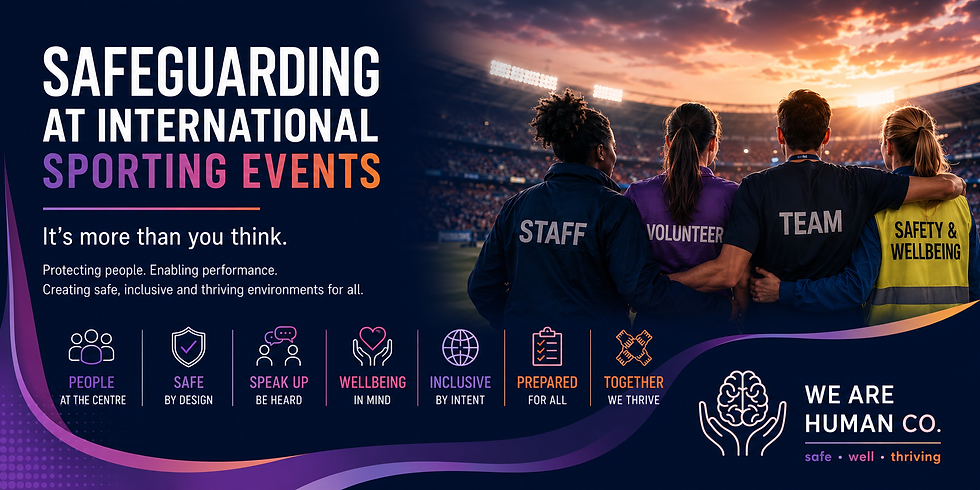
Safeguarding & Human Rights
for Events & Sporting Tournaments
Bringing together human rights, child safety, psychosocial risk, neuroscience, social impact and real-world event delivery to create physically & psychologically safer, more inclusive, human-centred event & tournament environments where people are respected, heard and protected from harm.

“We’re not here to improve safeguarding within the current system.
We’re here to redesign the system itself so safeguarding is no longer something organisations respond to, but something they are built around.”
Deanne Boules, Founder & Chief Enabling Officer, We Are Human Co | General Manager, Safety & Safeguarding, AFC Asian Women's Cup Australia 2026
What is Safeguarding?

Safeguarding is often misunderstood. Many people associate it only with children, schools, childcare settings or mandatory background checks. While protecting children and young people is a critical part of safeguarding, the concept is much broader.
Safeguarding can be understood as the measures taken to protect people from harm and to support their health, safety, wellbeing, dignity and human rights.
At its core, safeguarding is about creating environments where people are physically and psychologically safe, respected, heard and protected from abuse, exploitation, neglect, harassment, discrimination and other forms of harm.
It is about creating the conditions that enable people to participate, work, perform and engage safely and to speak up when something does not feel right.
Who does Safeguarding apply to?
Safeguarding applies to anyone who may be at increased risk of harm because of their age, circumstances, role, environment, dependence on others or the power dynamics around them.
This can include:
-
Children and young people
-
Adults at risk or people experiencing vulnerability
-
Employees, contractors and volunteers
-
Athletes, players and officials
-
Performers, artists and participants
-
People with disability
-
People from culturally and linguistically diverse backgrounds
-
First Nations peoples
-
People travelling or working away from home
-
People in temporary accommodation or unfamiliar environments
-
People experiencing isolation, illness, fatigue, trauma or distress
-
Suppliers, service providers and members of the community
A person may not always be considered vulnerable. Vulnerability can be temporary, situational or created by the environment. For example, a capable and experienced adult may become more vulnerable when they are:
-
Away from their usual support network
-
Working in an unfamiliar country or culture
-
Reliant on an organisation for accommodation, transport or access to services
-
Experiencing high pressure, fatigue or psychological distress
-
In a relationship where another person holds greater authority, influence or control
-
Afraid that speaking up may affect their employment, selection, reputation or future opportunities
This is particularly important in major events, sporting tournaments, touring environments, workplaces and community programs, where people may be brought together from different countries, cultures, ages and backgrounds under significant operational pressure.
Safeguarding is more than Child Protection
Child protection is one part of safeguarding, but safeguarding is not limited to responding after harm has occurred. It includes the actions organisations take to prevent harm, recognise emerging concerns, respond appropriately and create environments where people feel safe to raise issues.
Safeguarding may involve:
-
Preventing abuse, exploitation, harassment and neglect
-
Managing professional boundaries and power imbalances
-
Creating safe recruitment, screening and workforce practices
-
Supporting safe travel, accommodation and transport
-
Protecting people in digital and online environments
-
Ensuring people understand their rights and how to report concerns
-
Responding appropriately to disclosures, allegations and incidents
-
Supporting the welfare of people affected by harm
-
Managing risks associated with events, programs, teams and workplaces
-
Creating accessible and culturally appropriate reporting pathways
-
Ensuring leaders understand their responsibilities and act when concerns arise
Safeguarding must be built into how an organisation operates
Safeguarding is not achieved by having a policy, completing background checks or appointing one safeguarding officer.
Effective safeguarding must be embedded into the way an organisation is governed, led and operated.
It should influence:
-
Governance and leadership decisions
-
Event and program planning
-
Workforce planning and recruitment
-
Codes of conduct and expected behaviours
-
Training and induction
-
Risk assessment and operational planning
-
Travel, accommodation and venue arrangements
-
Reporting and escalation systems
-
Complaints and investigation processes
-
Crisis and incident management
-
Contractor and supplier management
-
Organisational culture and speaking-up environments
Safeguarding is strongest when it is understood as a shared responsibility rather than the responsibility of one person, team or function.

"Safeguarding in sport & events is the proactive design of environments, systems & cultures that protect the human rights, dignity, & wellbeing of all participants, particularly where power, vulnerability, or context increases the risk of harm"
Deanne Boules, Founder & Chief Enabling Officer, We Are Human Co | General Manager, Safety & Safeguarding, AFC Asian Women's Cup Australia 2026

At We Are Human Co, we take a holistic, human-centred and integrated approach to safeguarding and human rights.
We recognise that safeguarding does not sit separately from workplace health and safety, psychosocial safety, workforce welfare, participant wellbeing, governance, leadership and organisational culture.
These areas often overlap. Bullying, harassment, discrimination, sexual misconduct, violence, unsafe accommodation, fatigue, harmful power dynamics, poor reporting systems and inadequate support may create safeguarding, human rights, workplace safety and psychosocial risks at the same time.
We help individuals and organisations understand these intersections, identify where people may be vulnerable to harm and develop practical systems that protect:
-
Children and young people
-
Adults at risk
-
Employees and contractors
-
Volunteers and officials
-
Athletes, players and participants
-
Performers and touring personnel
-
Suppliers and service providers
-
Communities and members of the public
Our focus is not simply on compliance.
We help organisations create inclusive, respectful and accountable environments where people are safe, their rights are understood and protected, and they are enabled and empowered to thrive.
Our approach to Safeguarding

Our Safeguarding Services

Moving from policy to practice
Having a safeguarding policy does not necessarily mean an organisation is safeguarding-ready.
Effective safeguarding must be embedded into the way an organisation is governed, led and operated.
It should influence risk management, workforce planning, recruitment, reporting, escalation, training, culture, event delivery and the way people are supported when concerns arise.
The Safeguarding and Human Rights Readiness Sprint helps organisations understand whether their safeguarding approach will work in practice, not just on paper. The review considers:
• Governance and accountability
• Safeguarding and human-rights risks
• Policies and operating procedures
• Reporting and escalation pathways
• Recruitment, screening and workforce practices
• Education and workforce confidence
• WHS, psychosocial safety and wellbeing
• Incident response and organisational readiness
You receive a clear gap analysis, prioritised recommendations and a practical implementation plan.
Designed for sporting organisations, major events, associations, charities, community organisations and organisations responsible for children, young people or vulnerable adults.
Safeguarding Strategy & Frameworks

We help organisations develop a clear and coordinated approach to safeguarding that reflects their people, activities, risk profile and operating environment.
This may include:
-
Organisational safeguarding strategies and frameworks
-
Safeguarding governance and accountability structures
-
Roles, responsibilites and escalation pathways
-
Safeguarding implementation plans
-
Integration with risk, safety, people, operations & governance systems
-
Executive and Board safeguarding advice
Policy & Procedure Development
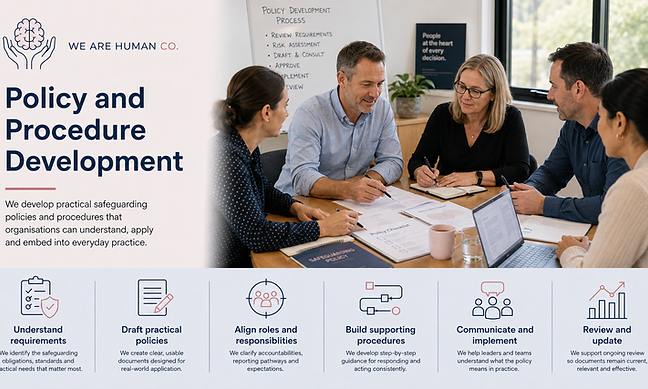
We help organisations develop a clear and coordinated approach to safeguarding that reflects their people, activities, risk profile and operating environment.
This may include:
-
Organisational safeguarding strategies and frameworks
-
Safeguarding governance and accountability structures
-
Roles, responsibilites and escalation pathways
-
Safeguarding implementation plans
-
Integration with risk, safety, people, operations & governance systems
-
Executive and Board safeguarding advice
Safeguarding & Human Rights Risk Assessments & Event Planning

We support organisations to identify, assess and manage safeguarding risks across workplaces, programs, events and activities.
Services may include:
-
Organisational safeguarding risk assessments
-
Program and activity risk assessments
-
Event and tournament safeguarding planning
-
Child and youth participation risk assessments
-
Travel and accommodation reviews
-
Venue and facility assessments
-
Workforce and volunteer risk assessments
-
Safeguarding emergency and escalation planning
-
Integration of safeguarding, WHS and psychosocial risks
We can support organisations from the early planning stages through to event delivery, incident response and post-event review.
Education & Training
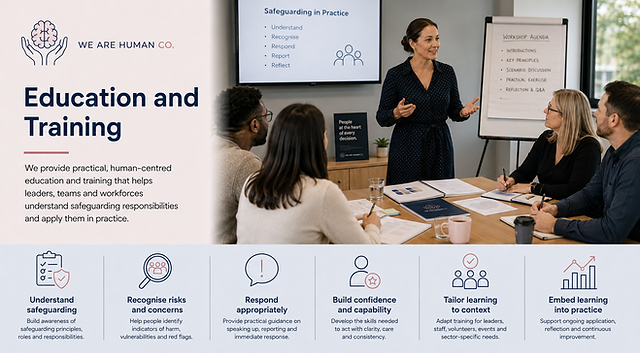
Policies only protect people when leaders, employees, volunteers and participants understand what safeguarding means and know what to do.
We provide practical, human-centred education and training for:
-
Boards and executive teams
-
Leaders and managers
-
Employees and contractors
-
Safeguarding officers and focal points
-
Volunteers and event workforces
-
Coaches, officials and support personnel
-
People working with children, young people or adults at risk
-
Human resources, safety and people and culture teams
Training can be tailored to the organisation, sector, workforce and level of safeguarding responsibility.
Safeguarding Resources & Workforce Support

We help organisations build the capability and resources required to manage safeguarding effectively.
This may include:
-
Safeguarding toolkits and implementation resources
-
Reporting guides, flowcharts and decision-support tools
-
Participant, parent, volunteer and workforce information
-
Safeguarding induction materials
-
Position descriptions and role requirements
-
Recruitment support for safeguarding roles
-
Safeguarding officer and focal-point development
-
Interim or embedded safeguarding leadership
-
On-site safeguarding teams for events and programs (i.e. Event safeguarding lead, Safeguarding Officers, Safeguarding advisory support during event operations, Incident response & escalation support)
-
Trained Team Liaison Officers
Expert Guidance & Advisory Support
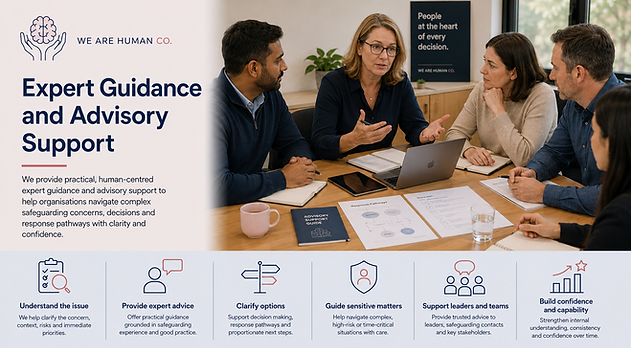
Safeguarding situations can be complex, sensitive and time-critical.
We provide confidential guidance to help organisations understand concerns, determine appropriate next steps and coordinate a proportionate response.
Support may include:
-
Safeguarding case consultation
-
Advice following disclosures, complaints or concerns
-
Reporting and escalation guidance
-
Support for leaders and safeguarding personnel
-
Complex stakeholder coordination
-
Independent review and decision support
-
Trauma-aware and culturally responsive guidance
-
Referral to specialist services where required
Crisis & Critical Incident Management
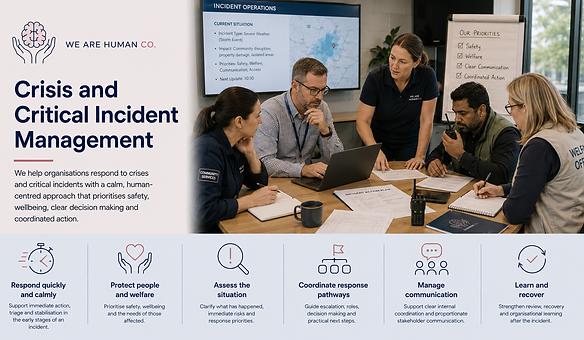
When a safeguarding incident occurs, the way an organisation responds matters.
We help organisations manage immediate safety, welfare, reporting, communication and operational requirements while keeping the people affected at the centre of the response.
This may include:
-
Immediate safeguarding advice and triage
-
Critical incident coordination
-
Welfare and support planning
-
Internal and external escalation
-
Stakeholder and agency coordination
-
Communication and information management
-
Post-incident reviews
-
Corrective action and organisational learning
-
Crisis preparedness and simulation exercises
Expert Guidance & Advisory Support
Safeguarding situations can be complex, sensitive and time-critical.
We provide confidential guidance to help organisations understand concerns, determine appropriate next steps and coordinate a proportionate response.
Support may include:
-
Safeguarding case consultation
-
Advice following disclosures, complaints or concerns
-
Reporting and escalation guidance
-
Support for leaders and safeguarding personnel
-
Complex stakeholder coordination
-
Independent review and decision support
-
Trauma-aware and culturally responsive guidance
-
Referral to specialist services where required
Safeguarding Reviews & Compliance Audits

We conduct independent reviews to help organisations understand whether their safeguarding arrangements are effective in practice, not simply whether documents exist.
Reviews may examine:
-
Governance and leadership oversight
-
Policies, procedures and codes of conduct
-
Recruitment and screening practices
-
Reporting and complaints systems
-
Training and workforce capability
-
Risk assessment and event planning
-
Recordkeeping and information management
-
Participant voice and accessibility
-
Organisational culture and speaking-up environments
-
Alignment with applicable safeguarding standards and regulatory requirements
Organisations receive clear findings, practical recommendations and an implementation roadmap.
Investigations & Independent Reviews

We provide human-centred support for safeguarding investigations, complaints and independent organisational reviews.
Our approach recognises the impact that fear, trauma, power, memory, culture and organisational dynamics can have on the way people experience and report events.
Services may include:
-
Preliminary assessments
-
Independent safeguarding investigations
-
Workplace and conduct investigations
-
Historical allegation reviews
-
Culture and systemic reviews
-
Witness and stakeholder interviews
-
Evidence assessment
-
Investigation planning and governance
-
Findings, recommendations and corrective actions
Regulatory & Legal Coordination
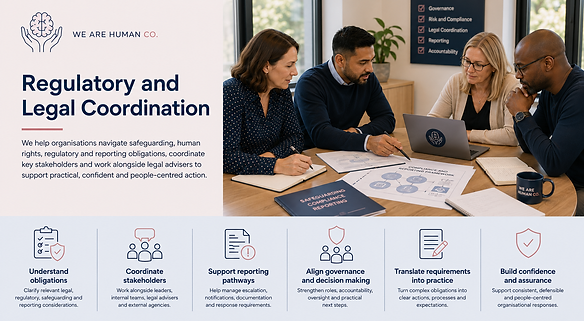
Safeguarding matters may involve multiple legal, regulatory, employment, safety and reporting obligations.
We help organisations understand the issues requiring consideration, coordinate relevant stakeholders and work alongside internal or external legal advisers where specialist legal advice is required.
This may include:
-
Regulatory and mandatory reporting coordination
-
Support engaging with police, regulators and other agencies
-
Preparation of information and documentation
-
Coordination with external legal advisers
-
Governance and executive briefings
-
Support implementing legal or regulatory recommendations
Safeguarding, WHS & Psychosocial Safety
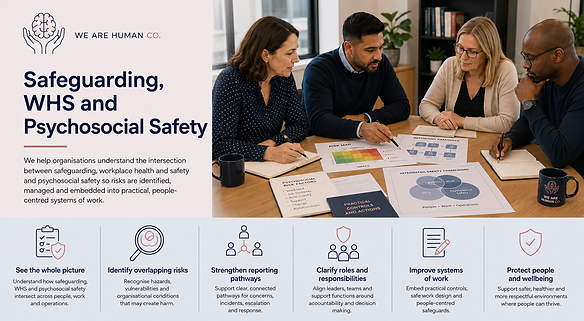
Safeguarding and workplace safety should not operate as disconnected systems.
Bullying, harassment, discrimination, sexual misconduct, violence, abuse, exploitation, fatigue, unsafe accommodation, poor reporting systems and harmful power dynamics may create safeguarding, psychosocial and workplace health and safety risks at the same time.
We help organisations identify these intersections and build a coordinated approach that protects participants, employees, contractors, volunteers and communities.
Building Safeguarding Capability, Not Dependency

Our role is not simply to hand an organisation another policy or become the only people capable of managing its safeguarding responsibilities.
We educate. We enable. We empower.
We work with organisations to strengthen internal understanding, confidence and capability so safeguarding becomes part of how decisions are made, people are supported and work is carried out every day.
Government Liaison & Funding Agreement Compliance
We provide practical support to help organisations understand, manage and demonstrate compliance with government funding agreements, grant conditions and associated safeguarding, human rights, governance and reporting obligations.
Our approach recognises that funding agreements often involve multiple stakeholders, complex requirements, strict timeframes and detailed evidence. We help translate these obligations into clear actions, responsibilities and systems that can be embedded into everyday operations.
״Safeguarding is strongest when it is understood as a shared responsibility rather than the responsibility of one person, team or function.״
Deanne Boules, Founder & Chief Enabling Officer, We Are Human Co | General Manager, Safety & Safeguarding, AFC Asian Women's Cup Australia 2026
Beyond the Game Framework
Protecting and enabling everyone who brings a tournament to life
Major events & sporting tournaments are more than just events. They are temporary workplaces, temporary communities, complex supply chains, high-pressure performance environments and public platforms with significant social influence.
Behind every concert, performance, match, ceremony, broadcast, volunteer shift, partner activation, venue build and player experience is a complex human ecosystem made up of people.
Beyond the Game is our human-centred framework for building safe, inclusive, ethical and socially responsible sporting tournaments and major events. It brings together six interconnected pillars:
Safe | Well | Protected | Respected | Responsible | Thriving
Driven by strong leadership, governance and culture, the framework helps organisations integrate physical safety, psychosocial safety, safeguarding, human rights, fair work, ethical procurement, environmental responsibility, social impact and legacy from the beginning.
Because a truly successful tournament or event does more than run on time, on budget and on broadcast schedule.
It protects people.
It respects rights.
It acts responsibly.
It creates lasting impact.
And it enables everyone who brings the event to life to thrive.

Safeguarding & Human Rights Training
Team Liaison Officer Training
Team Liaison Officers are often one of the closest and most trusted points of contact for teams during major tournaments and events. Yet too often, the role is treated as a logistics function, when in reality TLOs operate at the intersection of team services, communication, cultural safety, safeguarding, welfare, conflict resolution, event operations and crisis response and they play a critical role in the safety, experience and success of teams during tournaments and events.
Our Team Liaison Officer Training is one of the only dedicated TLO capability programs of its kind globally, designed specifically to prepare TLOs for the real human and operational complexity of the role.
This practical, human-centred program equips current and aspiring TLOs, Referee Liaison Officers (RLOs), team services staff, competition support staff and event workforce teams with the confidence, judgement and tools to support teams safely, respectfully and professionally in high-pressure tournament environments while taking care of their own health and wellbeing.
Participants learn how to coordinate team needs, communicate clearly under pressure, maintain professional boundaries, recognise welfare and safeguarding concerns, escalate appropriately, manage conflict and protect their own wellbeing throughout an event.
Available as an online course, in-person training program or train-the-trainer package, this program helps organisations build consistent, capable and confident TLO workforces who can protect the team experience and enable better event delivery.
Because TLOs are more than logistics support. They are trusted connectors between teams, organisers and the wider event environment.

Safeguarding Officer Training
Safeguarding Officers play a critical role in creating environments where people are protected from harm, concerns are recognised early, disclosures are received safely and responses are managed with care, confidence and professionalism.
Too often, safeguarding training focuses only on general awareness, policies, reporting pathways and compliance obligations. These matter, but they are not enough. Safeguarding Officers also need the human skills to communicate with care, respond to distress, understand trauma, maintain boundaries, gather information appropriately and support fair, safe and person-centred processes.
Our Safeguarding Officer Training is a practical, human-centred capability program designed for safeguarding officers, welfare leads, sport and event staff, volunteer leaders, people and culture teams, managers and organisational representatives.
Participants learn how to understand the scope of the safeguarding role, recognise signs of harm or risk, receive disclosures safely, communicate with empathy and clarity, apply trauma-informed principles, maintain confidentiality, assess immediate safety, escalate concerns, document appropriately and contribute to human-centred, trauma-informed investigations and reviews.
The program also builds core communication capability, including active listening, rapport building, asking appropriate questions, managing difficult conversations, explaining processes, supporting psychological safety and understanding how stress, trauma, memory, fear and power dynamics can affect what people say, remember and disclose.
Available online, in person or as a train-the-trainer solution, this program helps organisations move beyond compliance and build practical safeguarding capability that protects people, supports fair processes and strengthens trust.
Because effective safeguarding is not just about knowing what to report. It is about knowing how to respond when someone’s safety, dignity or wellbeing may be at risk.