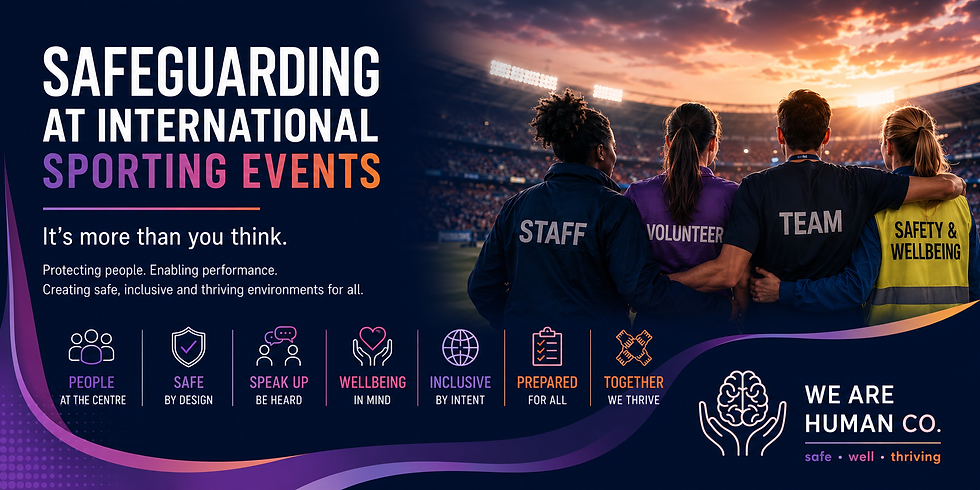
Beyond the Game
Protecting and enabling everyone who brings a tournament or event to life

Human-Centred Safety, Safeguarding & Social Impact for Major Events & Sporting Tournaments
Beyond the Game
Protecting and enabling everyone who brings a tournament or event to life
Major events and sporting tournaments are more than just events. They are temporary workplaces, temporary communites, complex supply chains, high-pressure performance environments and public platforms with significant social influence.
Behind everyone match, ceremony, broadcast, volunteer shift, partner or sponsor activation, venue build and player/entertainer experience is a complex human system made up of people.
Beyond the Game is a human-centred framework designed to help event organisers, sporting bodies, organising committees, host cities, funders, sponsors and event leaders build tournaments and events where people are physically & psychologically safe, respected, included, protected, treated fairly, enabled & empowered to thrive.
A new standard for responsible tournament / event design
A successful tournament is not just one that runs on time and on budget, fills stadiums and avoids major incidents.
A truly successful tournament is one where workforce, volunteers, contractors, players, officials, teams, partners, suppliers, sponsors, spectators, children, young people, adults at risk and host communities are protected and enabled to thrive.
The future of major sporting events requires more than compliance. It requires integrated, human-centred design that brings together:
-
Work health and safety
-
Psychosocial safety and workforce wellbeing
-
Safeguarding
-
Player welfare
-
Human rights and inclusion
-
Ethical procurement and fair work
-
Environmental responsibility
-
Corporate social responsibility and ESG
-
Social impact and legacy
Beyond the Game helps organisations move from fragmented compliance to integrated responsibility.

Why this matters
Tournaments and events are complex human ecosystems
Traditional event planning often treats safety, safeguarding, workforce wellbeing, human rights, sustainability and social impact as separate workstreams.
In real tournament environments, these issues are deeply interconnected. A volunteer who is exhausted, unclear about their role and afraid to speak up is not just a workforce issue. It may also be a WHS issue, a psychosocial risk issue, a service delivery issue and a safeguarding issue.
A youth program without clear supervision, escalation and accountability is not just an operational gap. It may create child safety, legal, reputational, human rights and wellbeing risks.
A contractor working long hours during bump-in and bump-out is not peripheral to the tournament. They are part of the human system that enables the event to happen.
A uniform or merchandise item is not just a brand asset. It may carry ethical supply chain, labour rights, environmental and modern slavery risks.
And a player under pressure, away from home, exposed to public scrutiny or navigating cultural and language barriers is not just experiencing a performance issue. It may also be a psychosocial safety, safeguarding, human rights, privacy, wellbeing and duty of care issue.
When these risks are not designed into the tournament from the beginning, they often emerge under pressure, when the ability to respond well is reduced.
Our Core Philosophy: Protecting & Enabling
Safety and safeguarding are often framed through the lens of preventing harm. Preventing harm is essential. But if the work stops there, we miss the bigger opportunity. The goal is not simply to avoid incidents, meet minimum obligations or have policies in place. The goal is to create conditions where people can participate, contribute, perform, speak up, feel respected, be included and thrive.
That means asking better questions.
Not just: Are we compliant? But:
-
Are people physically safe?
-
Are we protecting psychological health?
-
Are children, young people and adults at risk genuinely safeguarded?
-
Are people treated with dignity and respect?
-
Are workers, volunteers and contractors fairly treated?
-
Do people feel included, valued and connected to purpose?
-
Are our supply chains ethical?
-
Are our procurement decisions aligned with our values?
-
Are we protecting the environment?
-
Are we creating positive social impact?
-
Are we leaving people, communities and future events better because this tournament happened?
This is the shift from compliance to care, from risk management to responsibility, and from event delivery to social impact.
Beyond the Game Safeguarding Framework
Protecting and enabling everyone who brings a tournamnet to life


Major sporting tournaments are more than events. They are temporary workplaces, temporary communities, complex supply chains, high-pressure performance environments and public platforms with significant social influence.
Behind every match, ceremony, broadcast, volunteer shift, partner activation, venue build and player experience is a complex human system made up of people. Beyond the Game is a human-centred framework designed to help sporting bodies, organising committees, host cities, funders, sponsors and event leaders build tournaments where people are safe, respected, included, protected, fairly treated and able to thrive. It brings together 6 interconnected pillars:
1. SAFE: Physical safety, operational safety and WHS risk control
Protecting people from physical harm across the entire tournament ecosystem, including venues, transport, accommodation, contractors, bump-in and bump-out, fatigue, weather, crowd interfaces, emergency management and incident response.
2. WELL: Psychosocial safety, wellbeing and sustainable performance
Designing tournament environments that protect psychological health and support sustainable performance, including workload, fatigue, role clarity, recovery, communication, exposure to distressing incidents, online abuse, pressure to stay silent and psychological safety.
3. PROTECTED Safeguarding children, young people and adults at risk
Embedding practical safeguards across planning, workforce mobilisation, youth programs, transport, accommodation, change rooms, ceremonies, fan engagement, partner activations, reporting pathways, escalation protocols and crisis response. Safeguarding is not only about children. Vulnerability can be created by context, including age, disability, language, culture, fatigue, isolation, unfamiliar environments, dependency, power imbalance, intoxication, online exposure, large crowds, crisis and pressure.
4. RESPECTED: Human rights, dignity, inclusion, equity and access to remedy
Respecting people’s rights, identity, culture, voice and participation, including anti-discrimination, cultural safety, gender equity, disability access and inclusion, LGBTQIA+ inclusion, First Nations engagement, labour rights, safe participation for marginalised groups, accessible reporting pathways and protection from retaliation.
5. RESPONSIBLE: Corporate social responsibility, ethical practice, fair work, sustainable procurement and environmental stewardship
Ensuring tournaments act responsibly through what they buy, who they partner with, how they employ people, how they engage suppliers, how they use resources and how they manage environmental and social consequences. This includes ethical procurement, ethical supply chains for uniforms and merchandise, modern slavery risk controls, supplier due diligence, fair work practices, same job/same pay principles, equal pay rights, responsible sponsorship, social procurement, sustainable materials, waste reduction, circularity, energy and water use, transport impacts and end-of-event asset reuse or disposal.
6. THRIVING: Social impact, legacy, community benefit and long-term positive change
Designing tournaments that leave people, organisations, communities and future events better because they happened.
This includes volunteer experience and legacy, host community benefit, women and girls in sport, accessible participation pathways, sector capability in safeguarding, safety, inclusion and wellbeing, and stronger systems for future tournaments.